
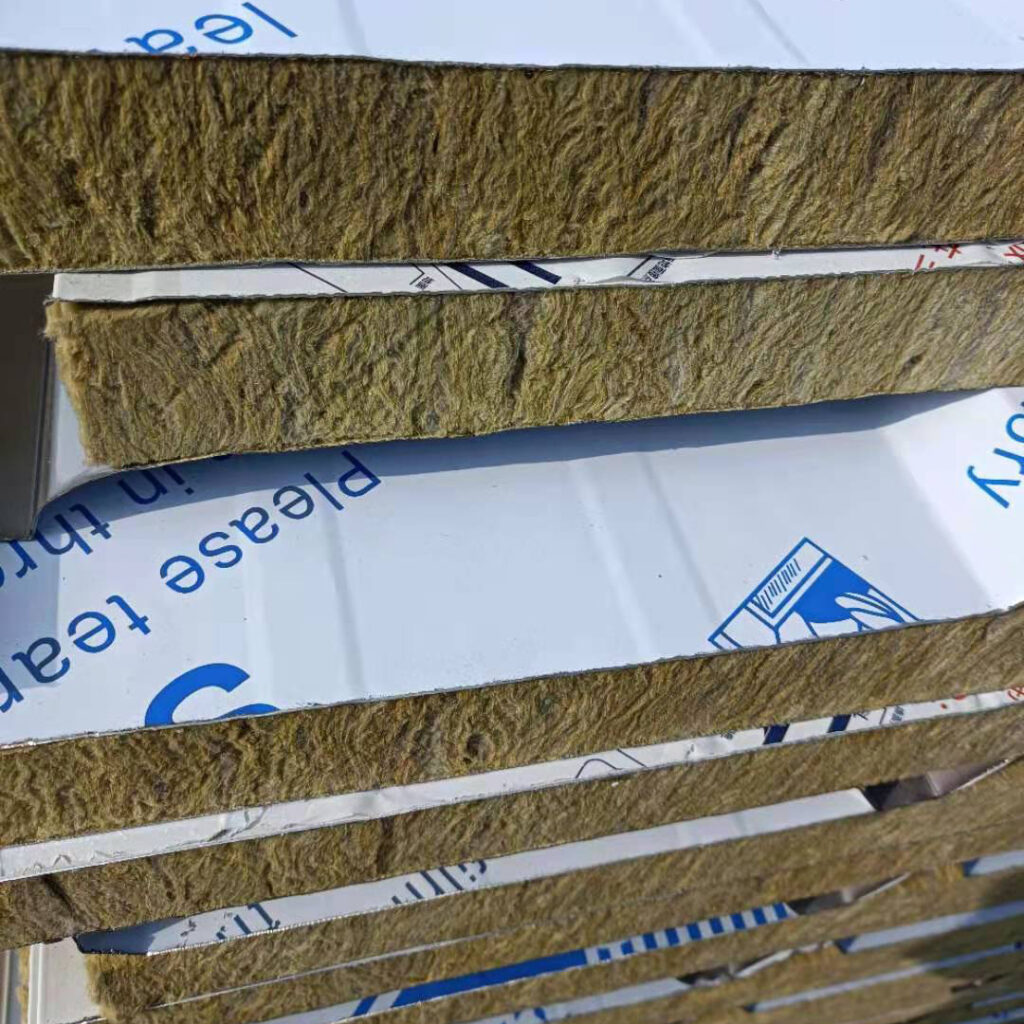
Product parameters:
Effective width: 1150 mm
Product thickness: 50 mm / 75 mm / 100 mm / 125 mm
Product density: 60kg / 80kg / 100kg
Product length: according to the user’s needs and engineering requirements and size production (generally ≤ 6000mm)
Product application:
Color steel fireproof rock wool mechanism composite board is suitable for pharmaceutical industry, food processing, medical and health, disease control, inspection and quarantine, optical technology, laser technology, precision instruments, microelectronics and other industries.
Raw Materials
- Core Material:
- Rock Wool: Made from basalt rock or slag (industrial byproduct), melted at high temperatures (≈1500°C) and spun into fibers. Often enhanced with binders (e.g., phenolic resin) and water-repellent additives.
- Facing Materials:
- Metal Sheets: Typically galvanized steel or aluminum, pre-coated with protective/paint layers for corrosion resistance.
- Other Options: May include fiberglass-reinforced foil or PVC layers for specific applications.
- Adhesives:
- High-temperature-resistant polyurethane (PU) or fireproof cement-based adhesives to bond rock wool to the metal skins.
- Accessories:
- Sealants, screws, or interlocking mechanisms for installation.
Production Process
Step 1: Rock Wool Core Manufacturing
- Melting: Basalt/slag is melted in a cupola furnace.
- Fiberization: Melted material is spun into fibers using centrifugal or blowing techniques.
- Bonding: Fibers are sprayed with binders and shaped into mats/boards via curing ovens.
Step 2: Metal Skin Preparation
- Cutting & Coating: Metal coils are unrolled, cut to size, and coated (primer/paint) for durability.
Step 3: Sandwich Panel Assembly
- Adhesive Application: Fireproof adhesive is evenly applied to metal sheets.
- Layering: Rock wool core is sandwiched between two metal skins under precision alignment.
- Pressing: Panels are compressed under high pressure (e.g., roller or hydraulic press) to ensure bonding.
Step 4: Curing & Finishing
- Curing: Adhesive is cured in a controlled-temperature chamber to solidify the structure.
- Cutting & Shaping: Panels are trimmed to final dimensions (e.g., via CNC cutting).
- Edge Treatment: Edges are sealed or reinforced for moisture/air tightness.
Step 5: Quality Control & Packaging
- Testing: Fire resistance (e.g., ASTM E84), thermal conductivity, and mechanical strength are verified.
- Packaging: Panels are stacked, wrapped, and labeled for shipment.
Key Features of the Final Product
- Fire Resistance: Withstands temperatures up to 1000°C (depending on thickness).
- Thermal/Acoustic Insulation: High-performance due to rock wool’s porous structure.
- Durability: Corrosion-resistant metal skins + hydrophobic core.
This streamlined process ensures a lightweight yet robust construction material widely used in buildings, industrial facilities, and cold storage.