
Abstract
Sandwich panels are widely used in industrial, commercial, and residential construction due to their excellent thermal insulation, lightweight properties, and ease of installation. However, fire safety regulations vary significantly across different regions, including the European Union (EN standards), the United States (FM/UL certifications), China (GB standards), and the Middle East (ESFR requirements). This paper provides a detailed comparison of these standards, certification processes, recommended testing institutions, and common failure cases to guide manufacturers and construction professionals in ensuring compliance and enhancing fire safety.
1. Introduction
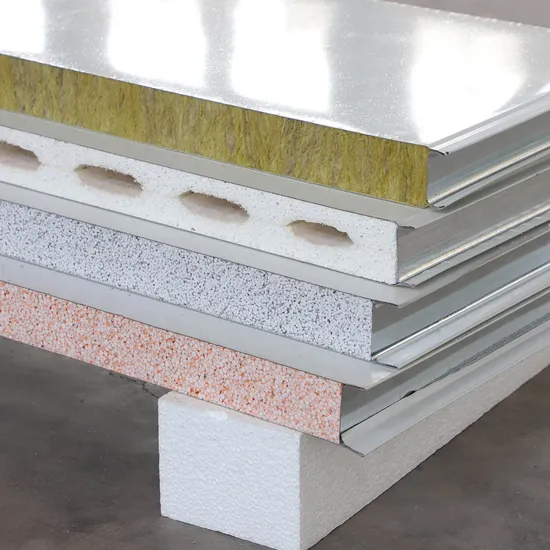
Sandwich panels consist of an insulating core (typically polyurethane (PUR), polyisocyanurate (PIR), mineral wool, or expanded polystyrene (EPS)) bonded between two metal or non-metal facings. Their fire performance is critical in building safety, and compliance with regional standards is mandatory for market access. This study examines:
- Fire resistance classifications (reaction to fire vs. fire resistance)
- Thermal insulation requirements
- Building code compliance
- Certification processes and testing bodies
- Common failure modes and solutions
2. Fire Safety and Building Standards by Region
2.1 European Union (EN Standards)
The EU follows harmonized standards under the Construction Products Regulation (CPR), with key norms:
- EN 13501-1 – Fire classification of construction products (Euroclasses A1 to F)
- EN 1364-1 – Fire resistance tests for non-load-bearing elements
- EN 13823 (SBI Test) – Assessment of fire behavior under single burning item conditions
Key Requirements:
- Core Material Impact: PIR/PUR cores typically achieve Euroclass B-s2,d0, while mineral wool achieves A1/A2 (non-combustible).
- Smoke & Droplet Emission: “s” (smoke) and “d” (droplets) classifications are crucial for public buildings.
2.2 United States (FM/UL Certifications)
The U.S. system relies on Factory Mutual (FM) Approvals and Underwriters Laboratories (UL) Standards:
- FM 4880 – Approval standard for insulated wall and roof panels
- UL 723 (ASTM E84) – Surface burning characteristics (Flame Spread Index & Smoke Developed Index)
- NFPA 285 – Fire propagation testing for exterior walls
Key Requirements:
- Combustibility Limits: FM-approved panels must resist internal fire spread (e.g., FM Class 1 for best performance).
- UL Listing: Required for insurance compliance; panels with foam cores often require thermal barriers.
2.3 China (GB Standards)
China’s GB standards are heavily influenced by EU and U.S. models but with localized adaptations:
- GB 8624-2012 – Fire classification (similar to Euroclasses, but with additional smoke toxicity criteria)
- GB/T 9978 – Fire resistance testing for structural elements
- GB 50016 – Building design fire code
Key Requirements:
- Stricter Smoke Toxicity Rules: Unlike EN standards, GB 8624 emphasizes CO/CO₂ emissions.
- Mandatory CCC Certification: Required for certain construction materials.
2.4 Middle East (ESFR & Civil Defense Requirements)
The Middle East, particularly the UAE and Saudi Arabia, follows:
- UAE Fire Code (ESFR – Early Suppression Fast Response) – Requires sprinkler-compatible panels
- SASO (Saudi Standards) – Often aligns with ASTM/UL but with enhanced fire resistance demands
- Civil Defense Approvals – Mandatory for high-rise buildings
Key Requirements:
- Non-Combustible Cores: Mineral wool is preferred in high-risk buildings.
- Enhanced Fire Resistance: 2-hour fire ratings are common for structural applications.
3. Certification Process & Testing Bodies
3.1 Steps to Obtain Certification
- Material Pre-Screening – Lab tests for combustibility, toxicity, and insulation.
- Full-Scale Testing – SBI (EU), NFPA 285 (U.S.), or GB/T 9978 (China).
- Factory Audits – FM/UL require manufacturing process reviews.
- Surveillance Testing – Annual retests for ongoing compliance.
3.2 Recommended Testing Institutions
- EU: BRE (UK), Efectis (Netherlands), MPA Braunschweig (Germany)
- U.S.: UL Solutions, FM Global, Intertek
- China: Tianjin Fire Research Institute, Shanghai Fire Testing Center
- Middle East: ESMA (UAE), SASO (Saudi Arabia)
4. Common Failure Cases & Solutions
4.1 Core Material Failures
- Issue: PUR/PIR cores may pass small-scale tests but fail in full-scale SBI/NFPA 285 due to rapid flame spread.
- Solution: Use fire-retardant additives or switch to mineral wool.
4.2 Insulation Degradation in High Temperatures
- Issue: EPS cores melt prematurely, leading to structural collapse.
- Solution: Use PIR or phenolic foam for better thermal stability.
4.3 Certification Delays Due to Documentation Errors
- Issue: Incomplete test reports or non-compliant factory processes.
- Solution: Engage accredited consultants early in the R&D phase.
5. Conclusion
Compliance with global sandwich panel standards requires a deep understanding of regional fire safety philosophies. While the EU emphasizes reaction-to-fire classifications, the U.S. focuses on large-scale propagation resistance, China imposes strict toxicity limits, and the Middle East demands high fire ratings. Manufacturers must tailor their products accordingly and engage with accredited testing bodies to avoid costly failures.
References
- EN 13501-1 (2018) – Fire classification of construction products
- FM 4880 (2021) – Approval standard for insulated panels
- GB 8624-2012 – Chinese fire safety standard for building materials
- UAE Fire and Life Safety Code (2021 Edition)