
The global construction industry is perpetually evolving, driven by demands for efficiency, sustainability, and performance. At the forefront of this evolution is a product that has redefined the possibilities of building envelopes: the panel sandwich. Far more than a simple composite material, panel sandwiches represent a sophisticated fusion of material science, precision manufacturing, and engineering ingenuity. As a leading manufacturer in this field, we delve into the multifaceted world of panel sandwiches, exploring their manufacturing process, market drivers, diverse applications, rigorous testing protocols, and the integral role they play in modern construction projects.
Market Perspective: Responding to Global Demands
The market for panel sandwiches is experiencing robust growth, propelled by several key trends. The urgent global push for energy efficiency is a primary driver. With buildings accounting for a significant portion of global energy consumption, the superior thermal insulation offered by panel sandwiches makes them an indispensable component for achieving stringent energy codes, such as Net Zero Energy standards.
Furthermore, the demand for speed in construction is higher than ever. The prefabricated nature of panel sandwiches allows for rapid assembly, significantly reducing on-site labor and overall project timelines. This “fast-track” construction capability is crucial for commercial, industrial, and logistics sectors where time directly correlates with cost and revenue generation. The rise of modular and prefabricated construction methodologies has further cemented the position of panel sandwiches as a core building material. Additionally, growing awareness of sustainable building practices has increased the demand for products with recyclable components and long life cycles, a niche where modern panel sandwiches excel.
Manufacturing and Engineering: The Heart of Quality
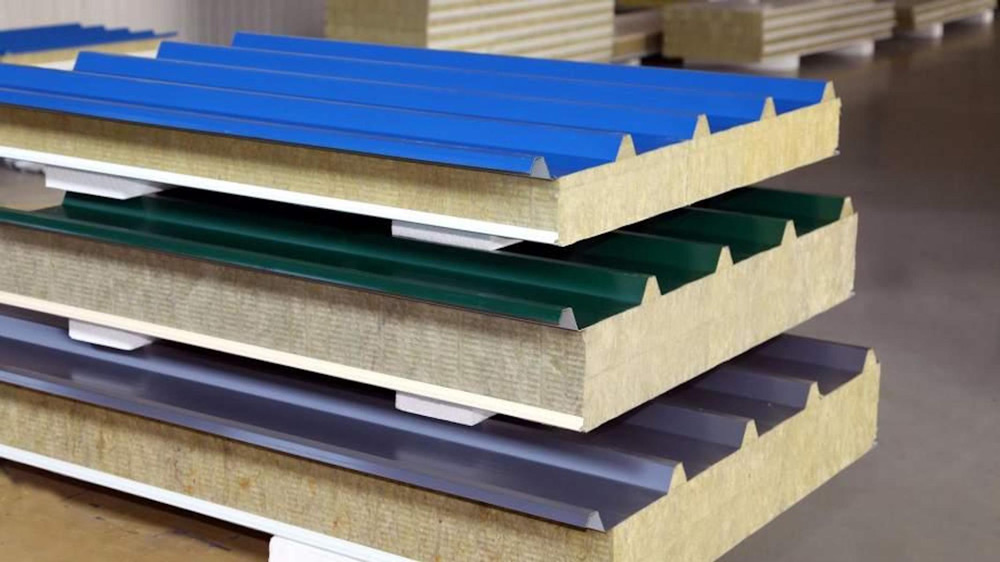
The performance of a panel sandwich is intrinsically linked to its manufacturing precision. The product’s anatomy is straightforward yet brilliant: two rigid facings bonded to a core of insulating material. However, the devil is in the details of its production.
- Material Selection:
- Facings: These determine the panel’s durability, aesthetic, and structural capacity. Common options include Galvanized Steel, Aluminium, Glass Reinforced Plastic (GRP), and Fibre Cement. Steel and aluminium facings can be pre-finished with PVDF or polyester coatings in a vast array of colors and textures, providing long-term corrosion resistance and minimal maintenance.
- Core Materials: The core defines the thermal and fire performance. Expanded Polystyrene (EPS) offers a cost-effective solution with good insulation. Polyurethane (PUR/PIR) foam cores provide superior thermal resistance (lower Lambda values) and enhanced fire-retardant properties. Mineral Wool cores are the gold standard for fire safety, offering non-combustible insulation, ideal for high-fire-risk environments.
- The Production Process: Advanced, continuous production lines are employed. The process involves automatically feeding the bottom facing sheet into the line, precisely dispensing the liquid core components (which then expand and cure into a foam), and simultaneously placing the top facing. The entire “sandwich” passes through a double-band laminator under controlled heat and pressure, ensuring a perfect, uniform bond between the facings and the core. This continuous process guarantees consistent quality, density, and thickness. Finally, the panels are cut to specified lengths, and, if required, high-precision computer-controlled machines profile the panel edges with interlocking joints (e.g., tongue-and-groove, shiplap) for seamless, weather-tight connections on-site.
Product Application and Versatility: Beyond the Obvious
The versatility of panel sandwiches is one of their greatest strengths. Their application extends across virtually every building sector.
- Commercial and Industrial Construction: This is the most common application. They are used for external walls and roofing for warehouses, factories, and cold storage facilities, providing an all-in-one solution for structure, insulation, and cladding. Their clean, modern appearance is also favored for office buildings and retail parks.
- Cold Storage and Controlled Environments: The exceptional thermal efficiency of PUR/PIR-cored panels is critical for refrigerated warehouses and food processing plants, minimizing energy loss and maintaining strict temperature controls.
- Cleanrooms and Pharmaceutical Facilities: Smooth, non-porous, and easy-to-clean surfaces make these panels ideal for environments requiring stringent hygiene standards. Sealed joints prevent particulate accumulation.
- Internal Partitions and Lining: Beyond external envelopes, they are used for internal walls and ceilings in offices, hospitals, and hotels, offering acoustic insulation and a finished appearance in a single install.
The Cornerstone of Project Execution: The Engineering and Construction Angle
From an engineering and construction management perspective, panel sandwiches simplify complex projects. Their prefabrication shifts a significant portion of the work from the unpredictable construction site to the controlled factory environment. This leads to:
- Reduced On-Site Risk: Less cutting, welding, and handling of multiple materials improve site safety.
- Predictable Scheduling: Manufacturing lead times are known, and on-site installation is rapid and less weather-dependent.
- Integrated Design: The panels function as both the building envelope and the insulation layer, streamlining the design and specification process for architects and engineers. Structural calculations account for the panel’s ability to span distances and resist wind loads, often eliminating the need for secondary support structures.
Assuring Performance: The Critical Role of Product Testing
A manufacturer’s claim is only as good as the data backing it. Rigorous, third-party testing is non-negotiable for a performance-critical product like panel sandwiches. Key testing areas include:
- Thermal Performance (K-value or R-value): Tests conducted in accordance with standards like EN 12667 or ASTM C518 verify the core material’s insulation efficiency, providing the critical data for energy modeling.
- Fire Performance: This is paramount. Tests evaluate Reaction to Fire (e.g., EN 13501-1, classifying panels into Euroclasses A1 to F) and Resistance to Fire (e.g., EI integrity and insulation ratings for 30, 60, 90, or 120 minutes), ensuring panels meet the required fire safety regulations for a given building type.
- Structural Performance: Panels are tested for load-bearing capacity under uniform (EN 14509) and wind suction/pressure loads to ensure they can withstand the environmental forces they will face throughout their lifespan.
- Durability and Weather Tightness: Accelerated aging tests, corrosion resistance checks on facings and joint systems, and water penetration tests validate the long-term integrity and weather resistance of the assembly.
Conclusion
Panel sandwiches are not merely a building product; they are a testament to how industrial manufacturing can solve complex construction challenges. They embody a holistic solution that addresses the critical pillars of modern architecture: speed, efficiency, safety, and sustainability. As a manufacturer committed to excellence, the investment in advanced production technologies, continuous R&D, and uncompromising testing protocols ensures that every panel that leaves our facility is engineered to perform, endure, and contribute to building a better, more efficient world. For specifiers and builders, choosing a high-quality panel sandwich is a strategic decision that pays dividends in project timeline, lifecycle cost, and overall building performance.