

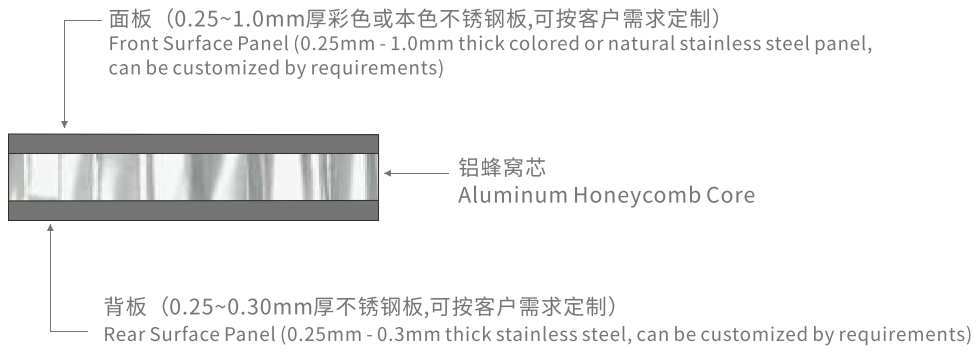
Stainless steel honeycomb panels, with a brushed stainless steel sheet or mirror stainless steel sheet for the surface and backing, and an aluminium honeycomb core or aluminium corrugated core for the core, laminated with a special adhesive. Stainless steel honeycomb panel is one of the honeycomb panels, stainless steel honeycomb panels often use brushed stainless steel panels or mirror stainless steel panels, its backing plate uses galvanized steel, the middle is used to aluminum honeycomb core, using adhesive bonding into. In particular, nickel-containing austenitic stainless steel honeycomb panels are aesthetically pleasing, making them popular for architectural applications and various surface finishes forinterior decoration.

Stainless Steel Honeycomb Sheet is a high-performance structural material known for its lightweight, high strength, and excellent corrosion resistance. Designed with a unique hexagonal honeycomb core and stainless steel face sheets, this product offers superior rigidity, durability, and thermal stability. It is widely used in aerospace, architecture, transportation, and industrial applications where strength-to-weight ratio and longevity are critical.
Raw Materials
Our Stainless Steel Honeycomb Sheets are manufactured using premium-grade materials to ensure reliability and performance:
- Core Material: High-quality stainless steel (304, 316, or customized grades)
- Face Sheets: Stainless steel sheets (varying thicknesses available)
- Adhesive/Bonding: High-strength epoxy or brazing techniques for robust bonding

Detailed Specifications
| Parameter | Description |
|---|---|
| Material Grades | 304, 316, 430, or customized |
| Thickness (Core) | 5mm – 100mm (customizable) |
| Cell Size (Hexagonal) | 3mm – 25mm (standard options) |
| Panel Thickness (Total) | 1mm – 50mm (adjustable) |
| Density | 30kg/m³ – 300kg/m³ (varies by structure) |
| Surface Finish | Brushed, mirror, sandblasted, or embossed |
| Temperature Resistance | -200°C to +800°C (depending on material) |
| Corrosion Resistance | Excellent (suitable for harsh environments) |
Manufacturing Process
- Material Selection: High-grade stainless steel sheets and honeycomb cores are precision-cut.
- Honeycomb Core Formation: Stainless steel strips are expanded or welded into a hexagonal structure.
- Bonding Process: The core is bonded to face sheets using high-strength adhesives or brazing under controlled heat and pressure.
- Pressing & Curing: The assembled panel is pressed and cured to ensure structural integrity.
- Finishing: Surface treatments (polishing, coating, or etching) are applied for aesthetics and functionality.


Applications
Stainless Steel Honeycomb Sheets are versatile and used in various industries:
- Aerospace: Lightweight panels for aircraft interiors and structural components.
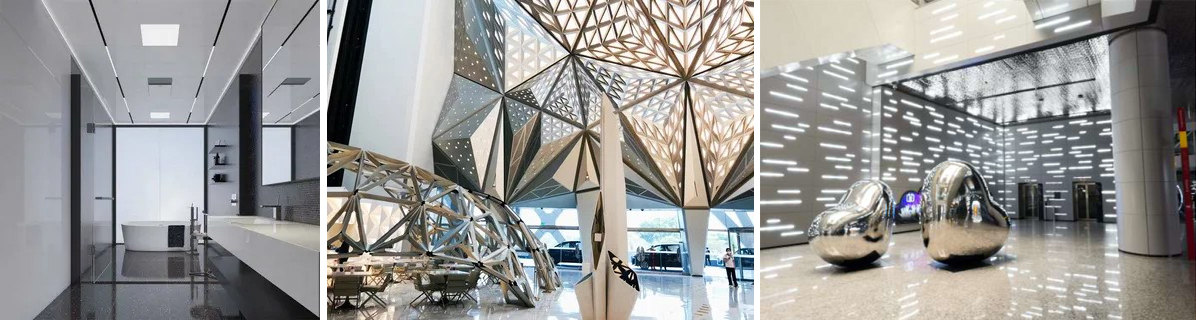
- Architecture & Cladding: Decorative facades, ceilings, and wall panels.
- Transportation: High-strength flooring and partitions in trains, ships, and EVs.
- Industrial: Heat exchangers, sound insulation, and vibration damping.
- Chemical & Marine: Corrosion-resistant equipment in harsh environments.
Installation Guide
- Measurement & Cutting: Ensure precise dimensions before cutting (laser/waterjet recommended).
- Mounting: Use stainless steel fasteners (screws, rivets) or structural adhesives for secure attachment.
- Sealing (if needed): Apply sealant for outdoor or wet environments to prevent moisture ingress.
- Maintenance: Clean with mild detergent; avoid abrasive tools to preserve the finish.

Why Choose Our Stainless Steel Honeycomb Sheets?
✔ High Strength-to-Weight Ratio – Strong yet lightweight.
✔ Corrosion & Heat Resistant – Ideal for extreme conditions.
✔ Customizable – Various sizes, materials, and finishes available.
✔ Eco-Friendly & Durable – Long lifespan with minimal maintenance.


Stainless Steel Honeycomb Sheet – 10 Construction & Installation FAQs
1. What tools are needed to cut Stainless Steel Honeycomb Sheets?
We recommend using laser cutting, waterjet cutting, or high-quality shearing tools for precise cuts. Avoid abrasive saws, as they may deform the edges.
2. Can the sheets be bent or shaped after production?
Limited bending is possible depending on thickness, but excessive bending may damage the honeycomb structure. For complex shapes, custom-formed panels are recommended.
3. How should the sheets be fastened to a structure?
- Mechanical Fastening: Use stainless steel screws, rivets, or bolts.
- Adhesive Bonding: High-strength epoxy or structural adhesives are suitable for seamless installations.
4. Are there special considerations for outdoor installation?
Yes. Ensure proper drainage and sealing at joints to prevent water accumulation. Grade 316 stainless steel is recommended for highly corrosive environments (e.g., coastal areas).
5. Can the honeycomb sheets be welded?
Yes, but only the face sheets should be welded—not the core. Excessive heat can weaken the honeycomb structure.
6. How do I prevent vibration or noise in applications like flooring or panels?
Apply damping materials (e.g., rubber pads or foam) between the sheet and the mounting surface to reduce resonance.
7. What is the maximum load capacity of these panels?
Load capacity depends on thickness, core density, and mounting method. Consult our technical datasheets or contact us for project-specific calculations.
8. How do I clean and maintain the sheets?
- Use mild soap and water for routine cleaning.
- Avoid chloride-based cleaners (risk of corrosion).
- For polished finishes, use non-abrasive cloths.
9. Can the sheets be used in high-temperature environments?
Yes, depending on the material:
- 304 Stainless Steel: Up to 800°C (1472°F) intermittently.
- 316 Stainless Steel: Better resistance but avoid prolonged exposure above 500°C (932°F).
10. Are custom sizes and shapes available?
Absolutely! We offer custom cutting, perforations, and special core designs to meet project requirements. Provide your specifications, and we’ll assist with fabrication.