


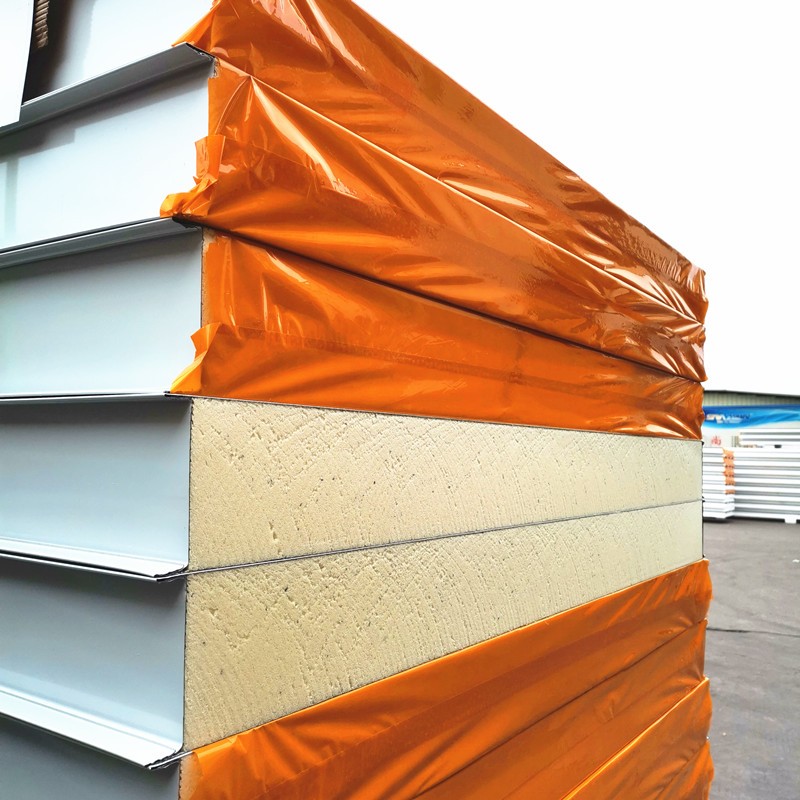
Polyurethane (PU) Sandwich Panels are high-performance building materials widely used in modern construction due to their excellent thermal insulation, structural strength, and lightweight properties. These panels consist of a rigid polyurethane foam core sandwiched between two metal or composite facings, making them ideal for industrial, commercial, and residential applications.
With superior energy efficiency, fire resistance, and durability, PU Sandwich Panels provide a cost-effective and sustainable solution for walls, roofs, and partitions in various construction projects.
Raw Materials
PU Sandwich Panels are manufactured using high-quality materials to ensure optimal performance:
- Core Material: Rigid polyurethane (PU) foam – offers outstanding thermal insulation (low U-value) and structural stability.
- Facing Materials:
- Galvanized steel, aluminum, or stainless steel (for corrosion resistance).
- Pre-coated steel with PVDF, HDPE, or polyester finishes (for enhanced durability and aesthetics).
- Adhesive: High-strength polyurethane-based adhesive for strong bonding between layers.
- Edge Details: Optional reinforced edges (e.g., tongue-and-groove, rebated) for better sealing and installation.
Technical Parameters
| Parameter | Specifications |
|---|---|
| Thickness | 30mm – 200mm |
| Panel Width | 1000mm – 1200mm (standard) |
| Panel Length | Up to 16m (customizable) |
| Core Density | 38 – 45 kg/m³ |
| Thermal Conductivity (λ) | 0.019 – 0.023 W/m·K |
| Fire Rating | B1 (Low flammability), Class 0 (UK), or Euroclass B-s1,d0 |
| Compressive Strength | ≥ 150 kPa |
| Operating Temperature | -50°C to +120°C |
| Surface Finish | Smooth, embossed, or profiled metal sheets (RAL colors available) |
Manufacturing Process
- Material Preparation:
- Metal sheets are cleaned, coated, and pre-cut to required dimensions.
- Polyurethane foam chemicals (isocyanate + polyol) are prepared for injection.
- Continuous Lamination:
- The bottom metal sheet is fed into the production line.
- Liquid PU foam is injected and expands between the two facing layers under controlled temperature and pressure.
- Curing & Cutting:
- The panel passes through a curing chamber to achieve full strength.
- Automated cutting machines trim panels to desired lengths.
- Quality Control & Packaging:
- Each panel undergoes inspection for thickness, adhesion, and surface quality.
- Panels are packed with protective film to prevent damage during transit.

Applications
PU Sandwich Panels are widely used in:
- Industrial & Warehouses: Insulated walls and roofs for factories, cold storage, and logistics centers.
- Commercial Buildings: Offices, supermarkets, and retail spaces requiring energy efficiency.
- Residential Construction: Prefabricated houses, modular buildings, and partition walls.
- Clean Rooms & Hospitals: Hygienic, easy-to-clean environments with thermal stability.
- Agricultural Structures: Poultry farms, dairy units, and greenhouse roofing.
Installation Guide
- Preparation:
- Ensure the supporting structure (steel frame/concrete) is level and secure.
- Check panel dimensions and required accessories (sealants, fasteners).
- Panel Placement:
- Install panels vertically or horizontally, starting from the corner.
- Use lifting equipment for large panels to avoid deformation.
- Fixing & Sealing:
- Secure panels with self-tapping screws (with EPDM washers) at recommended spacing (300-500mm).
- Apply silicone sealant at joints to prevent air/water leakage.
- Finishing:
- Install flashings, trims, and corner covers for a weatherproof finish.
- Inspect for gaps and reinforce if necessary.
Why Choose Our PU Sandwich Panels?
✔ Superior Insulation – Reduces energy costs with minimal heat transfer.
✔ Lightweight & Strong – Easy to install without compromising structural integrity.
✔ Fire-Resistant – Meets international safety standards.
✔ Customizable – Available in various thicknesses, colors, and finishes.
✔ Eco-Friendly – Low VOC emissions and recyclable materials.
Upgrade your construction projects with our high-performance PU Sandwich Panels—designed for durability, efficiency, and long-term savings.